LVT
Le Van Truong
01 · Research Program & Scientific Agenda

Investigating Evidence-Grounded Reasoning, Hybrid Retrieval, and Structural Inductive Biases.

My research program asks how machine learning systems can reason reliably over noisy, high-dimensional, real-world evidence—whether that evidence is a multilingual social-media stream, a 725,000-image personal lifelog, a statutory legal code, a disrupted urban road network, or a physiological video signal.

Primary Thesis · 01

Evidence-Grounded Reasoning

Standard dense embeddings compress complex claims into flat vectors that blur crucial factual predicates, dates, and temporal order. My primary research replaces surface similarity with structured evidence grounding: temporal Event Knowledge Graphs (ChronoSeek), retriever-aligned hard negative cross-encoders (SemEval/KES '26), and provenance-aware expert routing (GraphCURE).

10.8× MRR gain over CLIP in temporal lifelog retrieval & 0.9454 S@10 across 10 languages
Thesis 02

Diagnostic Failure Analysis

Empirical Auditing & Error Taxonomies

Thesis 03

Hybrid Analytical + Learned Priors

Inductive Biases Under Regime Shifts

Thesis 04

Research-to-Engineering Integration

Real-Time & Reproducible Systems

Interactive Research Atlas

Cross-Domain Research Topology

Interactive Topology · Drag & Click Any Node
6 Domains · 9 Synergy Links
Active: 01 · Fact Verification
01Fact Verification02RAG & Retrieval03Agentic Systems04LLMs & Reasoning05Graph ML06Vision & Sensing
Domain 012 Papers · 3 Systems

Automated Fact Verification & Evidence Reranking

Distinguishing semantically similar claims that differ in factual truth across languages and inference regimes.

Core Research Questions

  • How should negative examples be mined so that a Cross-Encoder reranker learns factual discrimination rather than surface lexical overlap?
  • Can we improve multi-class fact verification accuracy without updating model parameters by exploiting provenance-aware prediction history and constrained expert routing?

Key Methods

BiLSTM-Attention Token Pooling over Multilingual E5Retriever-Aligned Dense Hard Negative MiningCross-Encoder Reranking (BGE-M3 / PhoRanker)Constrained Expert Routing & Asymmetric NEI Deferral (GraphCURE)
Detailed Research Directions (01 — 06)

Six Interconnected Lines of Inquiry

Direction 01Fact Verification
2 Publications · 3 Engineering Systems

Automated Fact Verification & Evidence Reranking

Distinguishing semantically similar claims that differ in factual truth across languages and inference regimes.

Scientific Motivation

In real-world misinformation, false posts and verified claims frequently share topical vocabulary while diverging on a single critical predicate, date, or entity. Standard dense embeddings compress sentences into a single vector that blurs these fine-grained factual distinctions—especially across languages or when training updates are infeasible.
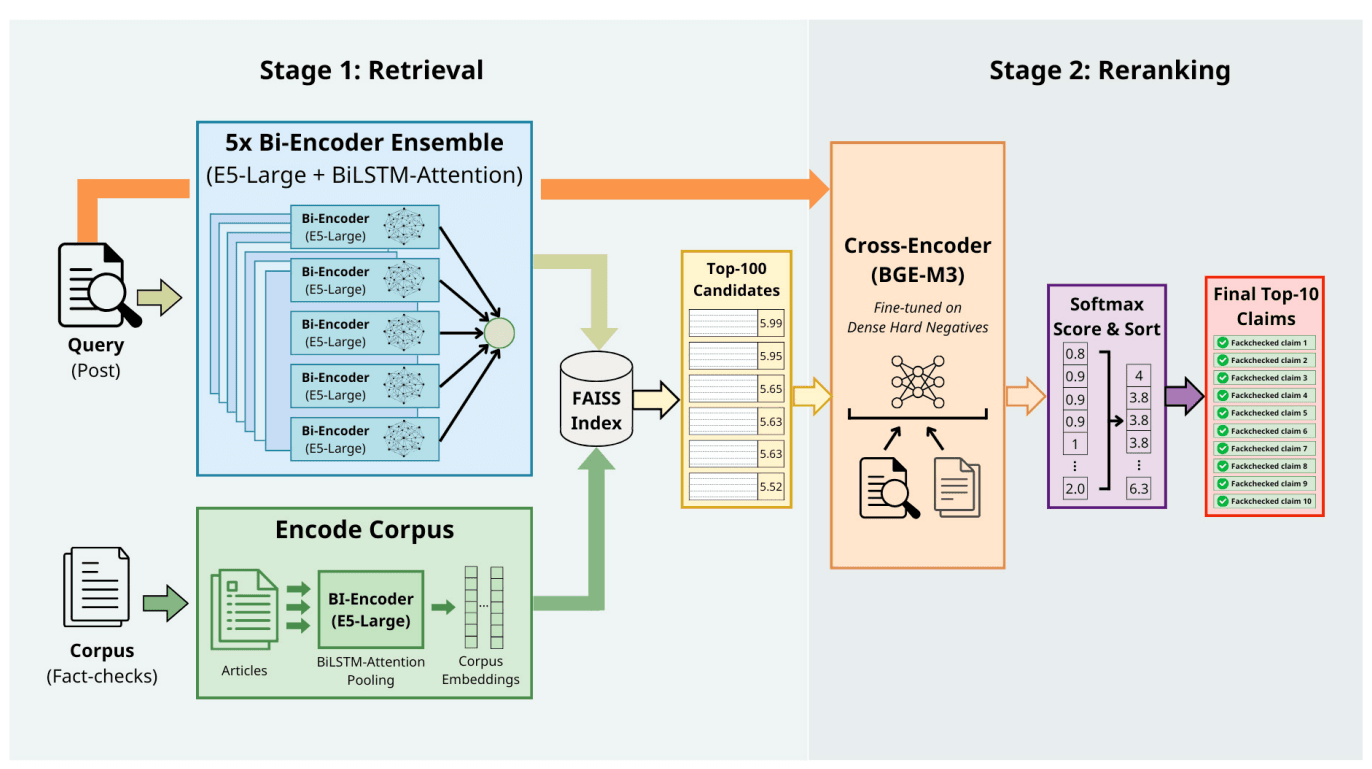
Two-stage multilingual fact-checking retrieval architecture with 5x Bi-Encoder Ensemble and BGE-M3 Cross-Encoder

Figure 1: Overview of the two-stage framework: 5× E5-Large + BiLSTM-Attention Ensemble (Stage 1) and Dense Hard-Negative BGE-M3 Reranker (Stage 2).

Core Research Questions

  • How should negative examples be mined so that a Cross-Encoder reranker learns factual discrimination rather than surface lexical overlap?
  • Can we improve multi-class fact verification accuracy without updating model parameters by exploiting provenance-aware prediction history and constrained expert routing?

Methods & Architectures

  • · BiLSTM-Attention Token Pooling over Multilingual E5
  • · Retriever-Aligned Dense Hard Negative Mining
  • · Cross-Encoder Reranking (BGE-M3 / PhoRanker)
  • · Constrained Expert Routing & Asymmetric NEI Deferral (GraphCURE)
  • · Training-Free Provenance Caching & Error-Conditioned Memory (ERRORFlow)

Benchmarks & Datasets

  • · SemEval-2025 Task 7 (10 Languages, 4,959 Test Queries)
  • · AVeriTeC / Evidence-Grounded Fact Verification Benchmarks
Direction 02RAG & Retrieval
2 Publications · 3 Engineering Systems

Hybrid Retrieval-Augmented Generation & Structured IR

Bridging lexical, dense vector, and graph-structured indices for high-precision, low-latency retrieval.

Scientific Motivation

Flat vector search degrades rapidly when queries involve temporal sequences, hierarchical statutory citations, or domain-specific Vietnamese terminology. Reliable RAG requires multi-view retrieval that fuses sparse lexical signals (BM25L), quantized vector indices (Milvus IVF-SQ8 / IVF-PQ, FAISS), and structured relational graphs.

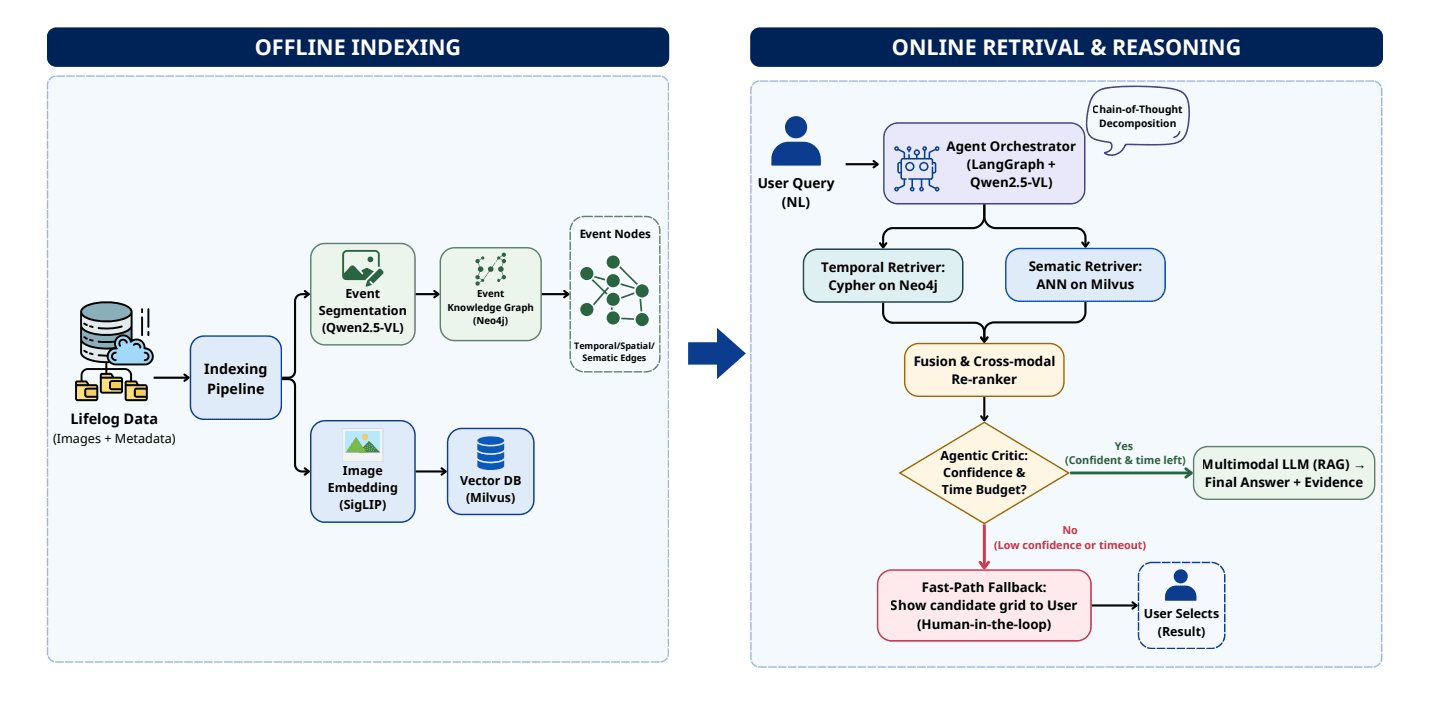
High-level architecture of ChronoSeek showing Offline Indexing and Online Retrieval & Reasoning

Figure 1: High-level architecture of ChronoSeek combining offline Event Knowledge Graph + Milvus indexing with online LangGraph Agentic Orchestration and Fast-Path fallback.

Core Research Questions

  • How can temporal and relational graph constraints (Cypher on Neo4j, Legal Citation GATs) guide dense vector search to eliminate global false positives?
  • How do we decouple multi-view candidate ranking from LLM generation to prevent judge bias while keeping end-to-end latency interactive?

Methods & Architectures

  • · Dual-Channel Hybrid Retrieval (Neo4j Cypher + Milvus ANN)
  • · Multi-View Legal Retrieval (BM25L + Dense + Graph Attention Network)
  • · Uncertainty-Aware Meta-Learner Late Fusion
  • · IVF-SQ8 & IVF-PQ Vector Quantization
  • · Two-Stage Retrieve-and-Rerank (halong_embedding + PhoRanker)

Benchmarks & Datasets

  • · ACM LSC '26 Lifelog Archive (725,949 Images, 33,471 Events)
  • · Vietnamese Legal Document & Citation Corpora (ViMELD)
  • · 100K Vietnamese News Benchmark (Global Tech)
Direction 03Agentic Systems
1 Publications · 3 Engineering Systems

Time-Bound Agentic AI & Multimodal Orchestration

Designing LangGraph orchestrators, confidence critics, and adaptive dialogue agents that operate under real-world latency budgets.

Scientific Motivation

Autonomous LLM agents often fail in live environments due to unbounded reasoning loops, ungrounded SQL/Cypher generation, or excessive time-to-first-frame latency. Practical agentic systems require explicit time budgets, quantitative confidence critics, schema grounding, and human-in-the-loop fast-path fallbacks.

High-level architecture of ChronoSeek showing Offline Indexing and Online Retrieval & Reasoning

Figure 1: High-level architecture of ChronoSeek combining offline Event Knowledge Graph + Milvus indexing with online LangGraph Agentic Orchestration and Fast-Path fallback.

Core Research Questions

  • How can an Agentic Orchestrator dynamically decompose multimodal temporal queries and abort into a human-in-the-loop Fast-Path before violating competition time limits?
  • How can adaptive agents combine VAD emotion modeling, speech-to-text, and low-latency streaming for interactive clinical training and conversational avatars?

Methods & Architectures

  • · LangGraph Chain-of-Thought Query Decomposition
  • · Time-Bound Agentic Critic & Fast-Path Human-in-the-Loop Fallback
  • · Valence-Arousal-Dominance (VAD) Emotion Modeling (CrisisX VR)
  • · In-Memory Native Audio-Driven Avatar Streaming (Faster-Whisper + Qwen2.5 + Wav2Lip)
  • · Schema-Grounded Semantic Planning (SPADEs / Text-to-SQL)

Benchmarks & Datasets

  • · 9th Annual Lifelog Search Challenge (LSC '26 Tasks 1, 2, 3)
  • · CrisisX Clinical VR Evaluation (14 Healthcare Students, UMUX-LITE)
  • · SyncNet Lip-Sync & Time-to-First-Frame Streaming Benchmarks
Direction 04LLMs & Reasoning
2 Publications · 3 Engineering Systems

LLM Reasoning Diagnostics & Inference Optimization

Auditing why frontier models fail on complex statutes and analyzing speculative decoding dynamics.

Scientific Motivation

Aggregate benchmark leaderboards frequently mask systemic reasoning failures—such as Claude 3 Opus scoring highest in overall legal accuracy while committing the largest number of subtle statutory misinterpretations, or GPT-4o stripping away legal conditions via safety-induced oversimplification.

Two-stage multilingual fact-checking retrieval architecture with 5x Bi-Encoder Ensemble and BGE-M3 Cross-Encoder

Figure 1: Overview of the two-stage framework: 5× E5-Large + BiLSTM-Attention Ensemble (Stage 1) and Dense Hard-Negative BGE-M3 Reranker (Stage 2).

Core Research Questions

  • Why do high surface accuracy scores fail to reflect legal reasoning reliability, and how do model architecture and RLHF alignment shape error profiles?
  • How can draft-model acceptance and rejection dynamics be mathematically profiled in speculative decoding?

Methods & Architectures

  • · Dual-Aspect Quantitative + Qualitative LLM Auditing
  • · 9-Category Legal Reasoning Error Typology (Cohen's κ = 0.72)
  • · Speculative Decoding Acceptance/Rejection Primitives (SPADE)
  • · Zero-Shot & Multi-Run Determinism Profiling

Benchmarks & Datasets

  • · 60 Curated Vietnamese Legal Articles (Penal Code, Civil Code, Land Law · 480 LLM Outputs)
  • · SPADE Offline Speculative Decoding Benchmark Suite
Direction 05Graph ML
2 Publications · 3 Engineering Systems

Spectral & Residual Graph Machine Learning

Combining analytical Laplacian spectral priors with residual GNNs—and diagnosing when priors become biased anchors.

Scientific Motivation

In spatially embedded infrastructure networks and citation graphs, purely data-driven GNNs ignore known mathematical physics (such as Fiedler eigenvalue derivatives), whereas purely analytical perturbation approximations fail under finite multi-edge disruptions. Combining them requires auditing domain shift across geographies.

High-level architecture of ChronoSeek showing Offline Indexing and Online Retrieval & Reasoning

Figure 1: High-level architecture of ChronoSeek combining offline Event Knowledge Graph + Milvus indexing with online LangGraph Agentic Orchestration and Fast-Path fallback.

Core Research Questions

  • When does learning a bounded GNN residual over a first-order Fiedler spectral sensitivity prior improve connectivity-loss estimation across 13 OpenStreetMap regions?
  • Under what failure regimes and geographic transfers does an analytical prior turn into a miscalibrated 'biased anchor'?

Methods & Architectures

  • · Bounded Residual Spectral Graph Learning (ŷ_spec + tanh r_θ)
  • · Laplacian Algebraic Connectivity (λ₂) & 12-Mode Second-Order Perturbation
  • · GCN, GraphSAGE, Edge-Aware MPNN & Graph Attention Networks (GAT)
  • · Area- and Country-Clustered Hierarchical Bootstrap Inference
  • · Amortized Sparse Eigensolver Screening

Benchmarks & Datasets

  • · 13 OpenStreetMap Road Networks across 6 Asian Countries (Vietnam, Singapore, Malaysia, Thailand, Taiwan, Japan)
  • · 20,000-Node Planar Road-Like Sparse Scaling Benchmark
Direction 06Vision & Sensing
4 Publications · 5 Engineering Systems

Computer Vision, Physiological Sensing & Biometric Privacy

Anatomical priors for rPPG vital-sign reconstruction, object-centric behavioral vision, and biometric super-resolution auditing.

Scientific Motivation

Vision and speech systems deployed in the wild face severe domain and artifact challenges: lower-face motion corrupts subtle skin blood-volume pulse signals, classroom background clutter confuses full-frame behavior classifiers, and image super-resolution hallucinates fingerprint ridges that distort privacy assessments.

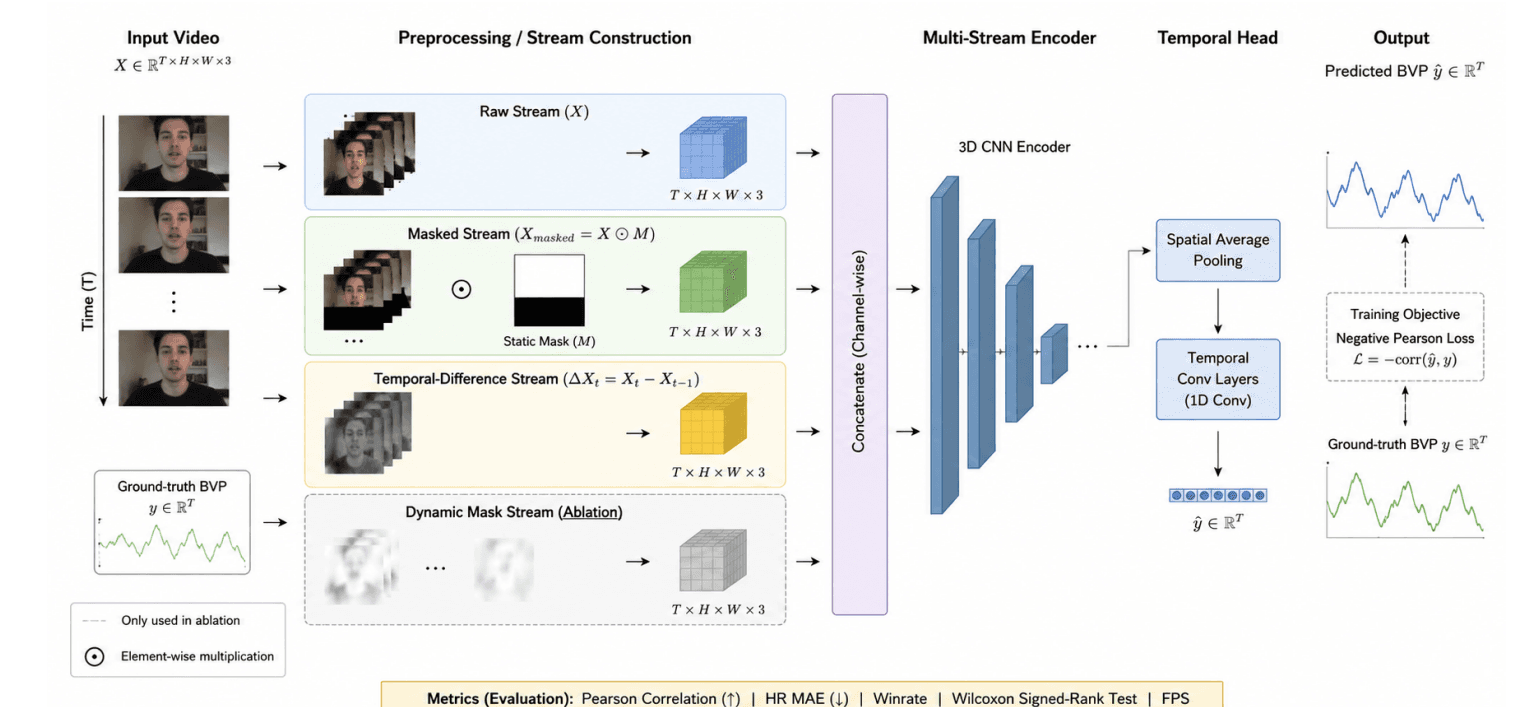
Overview of the SKIA multi-stream 3D-CNN framework for remote photoplethysmography

Figure 1: Overview of the SKIA framework combining raw frames, static lower-face suppressed frames, and temporal residuals.

Core Research Questions

  • Why does a static lower-face anatomical mask outperform dynamic optical-flow masking in remote photoplethysmography (SKIA)?
  • Does increasing fingerprint minutiae count via SwinIR super-resolution actually cause cross-domain biometric identity leakage (FLeX)?
  • How much does object-centric ROI isolation improve real-time behavioral classification at scale?

Methods & Architectures

  • · Multi-Stream 3D-CNN with Static Spatial-Knowledge Masking (SKIA-Net)
  • · Negative Pearson Correlation Waveform Optimization
  • · Multi-Level Biometric Leakage Protocol (SwinIR + MINDTCT + Bozorth3)
  • · Two-Stage Object-Centric Vision (YOLOv8n + RexNet-150)
  • · Prosodic-Gated wav2vec2 & Hierarchical Mixture-of-Experts (ViProDID)

Benchmarks & Datasets

  • · UBFC-rPPG (42 Subjects, Contactless BVP & Heart Rate)
  • · ISPFDv2 Fingerprint Benchmark (71,040 Contactless Probes, 2,368 Livescan Gallery)
  • · 10-Source Consolidated Exam Behavior Benchmark (273,897 Samples)
  • · ViMD 63-Province Speaker-Disjoint Speech Corpus