FLeX Biometric Privacy Pipeline
Multi-Level Fingerprint Super-Resolution & Cross-Domain Identity Leakage Evaluation
A large-scale biometric privacy evaluation pipeline testing whether super-resolution (Bicubic, SwinIR, ESRGAN) increases identity leakage from degraded contactless finger-selfies across 71,040 probe images and 2,368 livescan templates on ISPFDv2 (Accepted at FDSE 2026, Springer CCIS).
The Technical Bottleneck
Smartphone finger-selfies can be captured casually at a distance. A critical security question is whether applying modern image super-resolution to low-resolution finger-selfies reconstructs genuine ridge topology that leaks biometric identity against official livescan databases.
Why Existing Baselines Fail
Prior image restoration studies stop at PSNR/SSIM or minutiae counts. We hypothesized that enhancement and generic super-resolution can hallucinate ridge-like artifacts that dramatically inflate minutiae counts without actually matching the subject's true livescan fingerprint.
Core Formulation & Insight
FLeX links three evaluation tiers in a single reproducible pipeline over 30 synthetic degradation regimes (downscaling, JPEG compression, Gaussian blur, noise): (1) Image fidelity (PSNR, SSIM, AlexNet LPIPS), (2) CLAHE + adaptive Gaussian enhancement + NIST MINDTCT minutiae extraction, and (3) NIST Bozorth3 cross-domain contactless-to-livescan matching (142,080 genuine and impostor comparisons per representation).
Architectural Design
Three-tier biometric evaluation pipeline connecting super-resolution inference, CLAHE ridge enhancement, MINDTCT template generation, and Bozorth3 cross-domain verification.
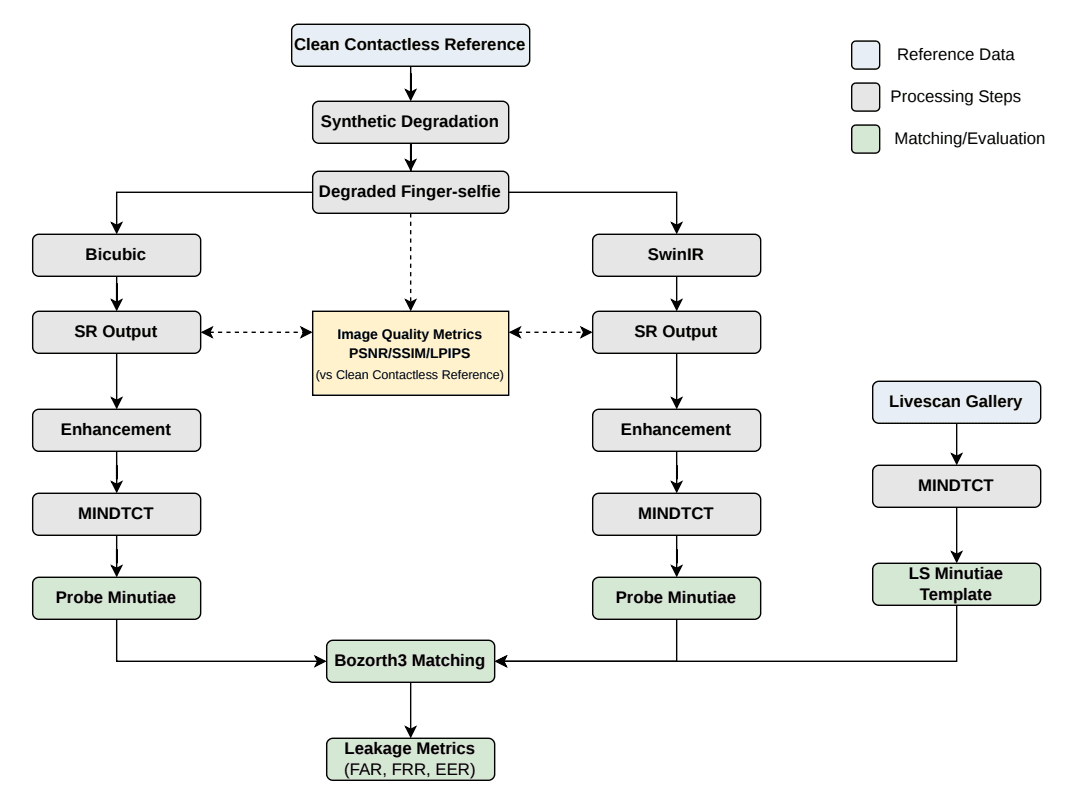
FLeX three-level leakage evaluation pipeline (FDSE 2026, Springer CCIS).
1. 30-Condition Synthetic Degradation & Super-Resolution
Evaluates 71,040 contactless images across scales s ∈ {32..512}, JPEG q ∈ {25..100}, blur kernels k ∈ {3,5,7}, and noise σ ∈ {5,10,20} reconstructed via Bicubic and SwinIR-M (standardized to 512×512).
2. Ridge Enhancement & NIST MINDTCT Extraction
Applies CLAHE (clip limit 2.0, 8×8 tiles), 3×3 Gaussian smoothing, and adaptive Gaussian thresholding before extracting `.xyt` minutiae templates via MINDTCT.
3. Cross-Domain Bozorth3 Matching & EER Analysis
Matches 71,040 contactless probes against 2,368 livescan gallery templates to compute genuine/impostor distributions, FAR, FRR, ROC curves, and Equal Error Rate (EER).
Technical Stack & Systems Engineering
Implementation Highlights
- →Engineered standardized manifest linking, batched GPU inference, and automated NBIS MINDTCT/Bozorth3 wrapper pipelines processing 71,040 probe images.
- →Verified NBIS discriminability via a same-domain livescan sanity check (genuine mean 101.81 vs. impostor mean 9.29, EER = 0.0638).
Datasets & Protocol
Datasets & Corpora
- ISPFDv2 (35,520 BI + 35,520 RES contactless probes; 2,368 LS livescan gallery images)
Evaluation Protocol
Identical-sample comparison of Raw Contactless, Clean Contactless + Enhancement, Bicubic, and SwinIR + Enhancement across image quality, minutiae count, and cross-domain matching EER.
Tracked Evaluation Metrics
Proved that while SwinIR + enhancement increases extracted minutiae by 3.86× (51.19 → 197.50), cross-domain matching EER remains near random (0.4998), refuting naive minutiae-count leakage assumptions.
Bicubic outperforms generic SwinIR across PSNR, SSIM, and LPIPS
3.86× increase in detected minutiae (421.94 on enhanced clean contactless)
No genuine-impostor separation vs. 0.0638 same-domain livescan EER
Empirical Analysis & Interpretation
Visual restoration quality and minutiae abundance are insufficient proxies for biometric privacy leakage; downstream identity-consistent matching is mandatory.
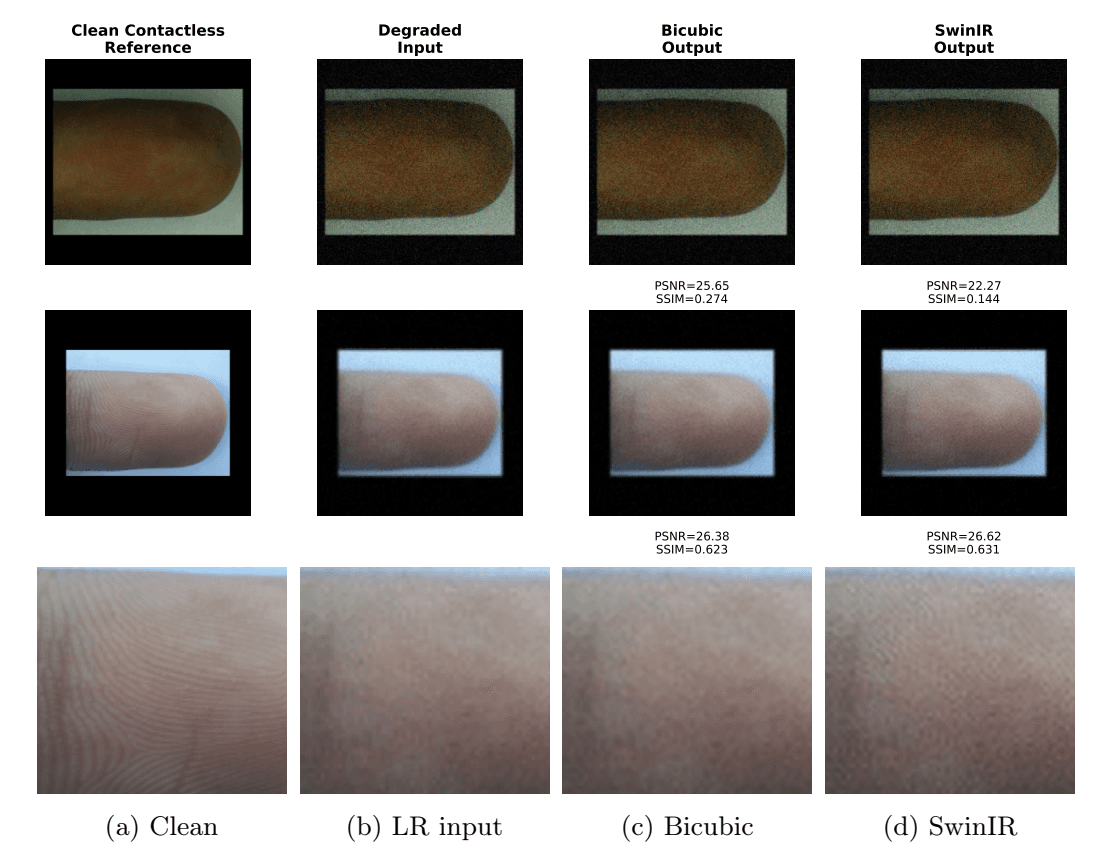
Visual and magnified ridge comparison across Clean, Degraded LR, Bicubic, and SwinIR outputs.
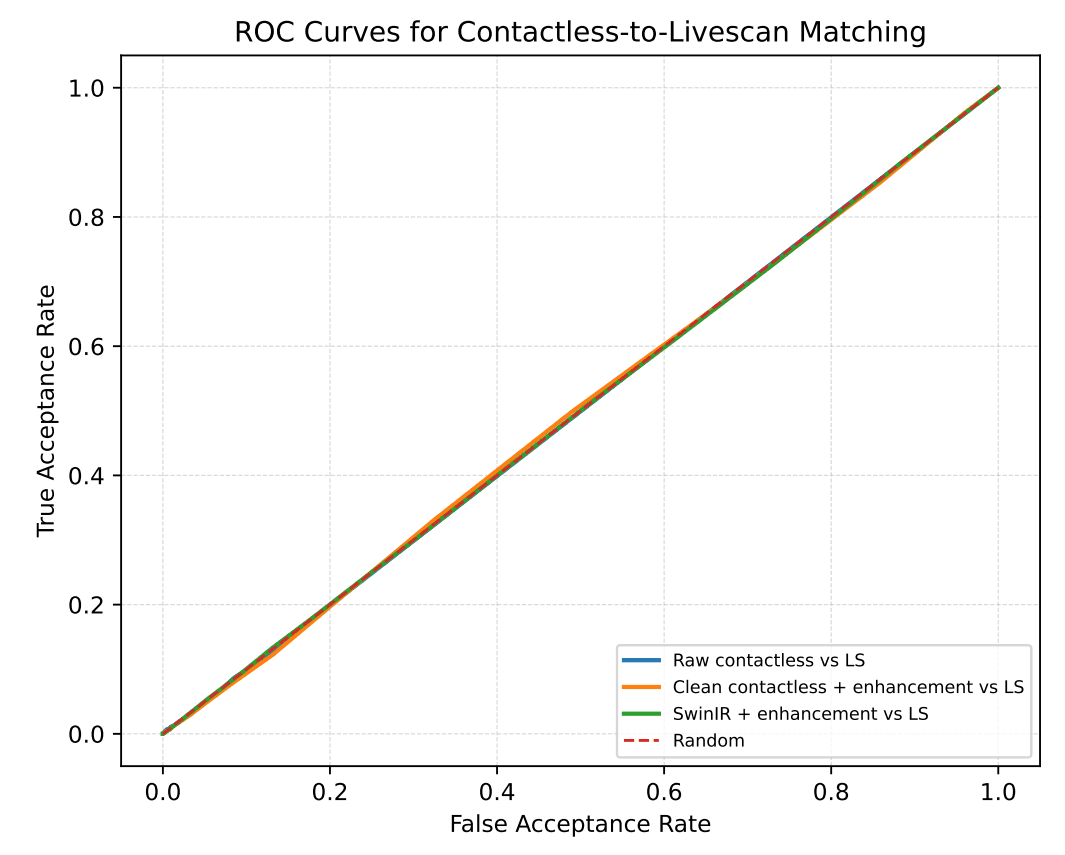
ROC curves for contactless-to-livescan matching confirming near-random EER ≈ 0.5.
What This System Contributes
- 01First author: designed the three-level leakage protocol, implemented the evaluation pipeline, analyzed the 71,040-image results, and authored the FDSE 2026 paper.
Boundary Conditions & Future Work
- ·Evaluates generic SwinIR and classical NBIS matching; extended G2 pipeline runs (~497K images with ESRGAN) are tracked in the private research repository.
FLeX: Fingerprint Leakage Evaluation across Super-Resolution and Cross-Domain Matching
Van-Truong Le, Le-Khanh Nguyen, Tran-Chau Vo Han, Hieu-Hoc Tran Minh, Minh-Triet Tran