Enhancing Multilingual Fact-Checking Retrieval with Ensemble Bi-Encoders and Architecture-Aware Hard Negative Reranking
1University of Science, Vietnam National University Ho Chi Minh City (VNU-HCM) · SELab
30th International Conference on Knowledge-Based and Intelligent Information & Engineering Systems (KES 2026), Procedia Computer Science 292 (2026) 1845–1853
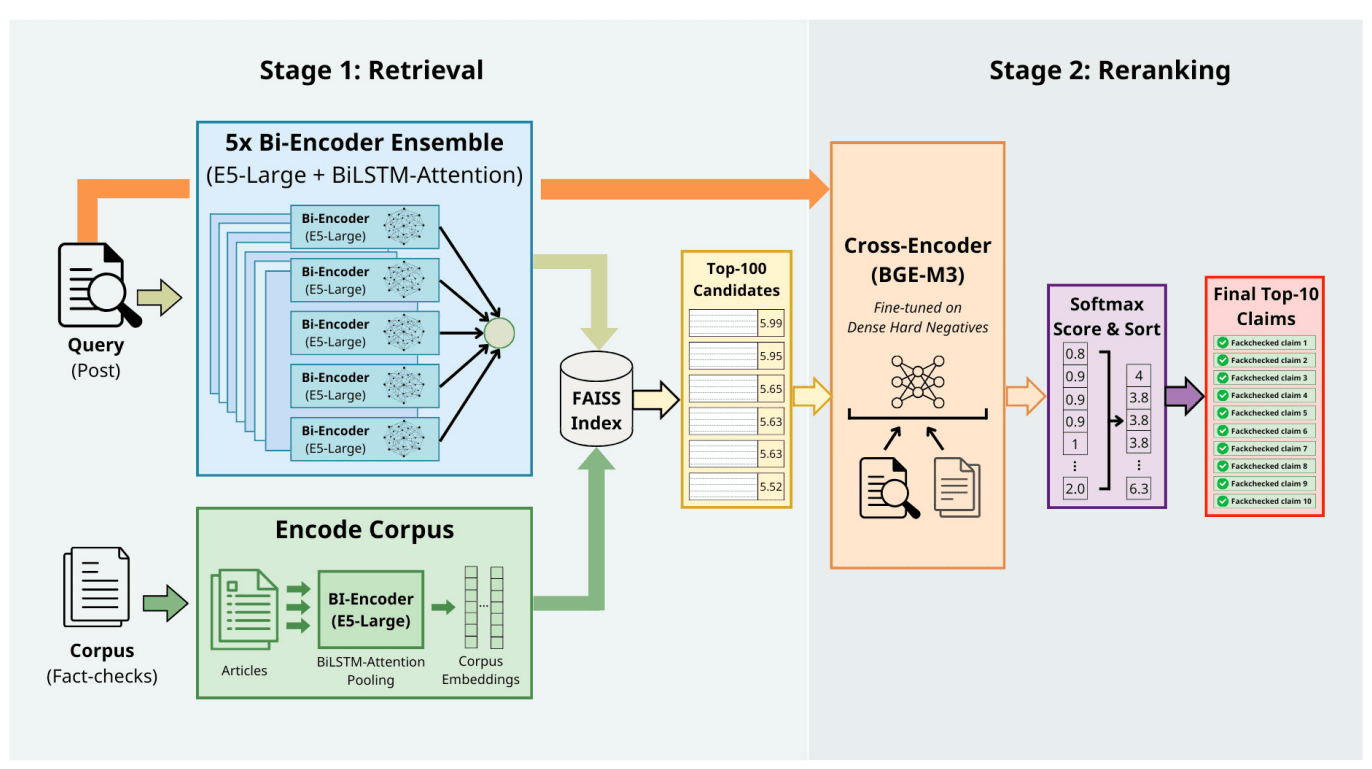
Figure 1: Figure 1: Overview of the two-stage framework: 5× E5-Large + BiLSTM-Attention Ensemble (Stage 1) and Dense Hard-Negative BGE-M3 Reranker (Stage 2).
+8.0% over Stage-1 Dense Ensemble (0.8033) & +2.46% above 1st-place PINGAN AI (0.8587)
Monolingual S@10 = 0.9215; reduces mono-to-cross-lingual gap from 9.40% to 3.82%
Dense-mined hard negatives (0.9163) vastly outperform Random (0.8049) and BM25-mined (0.2015)
Paper Abstract
Multilingual fact-checking requires retrieving relevant verified claims across languages, a task where dense retrievers often struggle to precisely rank top candidates, especially in cross-lingual settings. In this work, we propose a two-stage retrieve-then-rerank pipeline, combining an ensemble of Bi-Encoders for candidate generation with a Cross-Encoder reranker trained using semantically mined hard negatives. Experiments on the SemEval-2025 Task 7 dataset show that reranking significantly improves performance, yielding an 8.0% absolute gain in cross-lingual retrieval. Our analysis further shows that semantically aligned hard negatives are critical for effective reranking, whereas lexically derived negatives can substantially degrade performance.
Research Motivation
In multilingual fact-checking, social media claims and verified fact-checks often share no lexical overlap across languages, yet semantically similar claims may differ in factual truth. Standard mean-pooled dense retrievers dilute sparse evidence tokens, and rerankers trained on lexical (BM25) negatives fail to resolve fine-grained cross-lingual semantic ambiguity.
Guiding Research Questions
- RQ1How much does sequential token-importance pooling (BiLSTM-Attention) and multi-seed Bi-Encoder ensembling improve candidate generation across 10 languages?
- RQ2How do different negative sampling distributions (Random, BM25-mined lexical, vs. Stage-1 Dense-mined semantic hard negatives) govern Cross-Encoder reranking effectiveness?
Methodology & Architecture
We formulate a two-stage retrieval pipeline evaluated on SemEval-2025 Task 7 (19,956 train, 2,259 dev, and 4,959 test pairs across 8 seen languages plus zero-shot Polish and Turkish). Stage 1 augments `intfloat/multilingual-e5-large-instruct` with a custom BiLSTM-Attention pooling layer (hidden dimension 512) trained with MultipleNegativesRankingLoss (τ = 0.05) across a 5-seed ensemble indexed in FAISS. Stage 2 fine-tunes a `BAAI/bge-reranker-v2-m3` Cross-Encoder (568M params) on the top-10 dense-mined hard negatives retrieved directly from Stage 1.
Stage 1: 5× Bi-Encoder Ensemble (`multilingual-e5-large-instruct` + custom BiLSTM-Attention pooling) generating Top-100 candidates via FAISS → Stage 2: Cross-Encoder (`BAAI/bge-reranker-v2-m3`) fine-tuned on Stage-1 Dense Hard Negatives producing final Top-10 verified claims.
- · SemEval-2025 Task 7 Multilingual & Cross-Lingual Fact-Checked Claim Retrieval Benchmark (10 languages: Arabic, English, French, German, Malay, Portuguese, Spanish, Thai + zero-shot Polish & Turkish; 4,959 test queries)
Success@10 (S@10) · Success@5 (S@5) · Success@1 (S@1) · Monolingual vs. Cross-Lingual Gap
Primary Contributions
- 01Proposed a two-stage multilingual fact-checking pipeline combining a 5-model BiLSTM-Attention E5-Large ensemble with a BGE-M3 Cross-Encoder reranker.
- 02Achieved 0.8833 Cross-Lingual S@10 and 0.9163 Overall S@10 on SemEval-2025 Task 7, surpassing the competition winner in cross-lingual retrieval by 2.46% absolute.
- 03Proved empirically that lexical BM25-mined negatives cause severe reranker collapse (0.2015 S@10) whereas retriever-aligned dense hard negatives are decisive.
Analyzed Boundary Conditions
- ·Cross-Encoder reranking over top-K candidates increases inference compute compared to standalone dense retrieval.
- ·OCR text extracted from social media images is consumed as flat text without direct visual modality grounding.
BibTeX Entry
@article{le2026enhancing,
  author  = {Le, Van-Truong and Nguyen-Tran, Duy-Minh and Le, Tung and Nguyen, Huy Tien},
  title   = {Enhancing Multilingual Fact-Checking Retrieval with Ensemble Bi-Encoders and Architecture-Aware Hard Negative Reranking},
  journal = {Procedia Computer Science},
  volume  = {292},
  pages   = {1845--1853},
  year    = {2026},
  note    = {30th International Conference on Knowledge-Based and Intelligent Information & Engineering Systems (KES 2026)},
  publisher = {Elsevier}
}