Object-Centric Exam Cheating Detection
Two-Stage YOLOv8n + RexNet-150 Behavioral Analysis over 273,897 Samples
A real-time, two-stage computer vision pipeline decoupling examinee localization (YOLOv8n) from fine-grained behavioral classification (RexNet-150) across a consolidated 273,897-sample dataset from 10 public sources. Achieves 95.16% test accuracy (+16.64% over full-frame baseline) at 13.9 ms/sample latency (FJCAI 2026).
The Technical Bottleneck
Automated exam proctoring models trained on full classroom frames fail because background clutter dominates the image and multiple students appear simultaneously, leading to low precision (0.65) and recall (0.61) on actual cheating behaviors.
Why Existing Baselines Fail
Isolating each examinee into a normalized Region of Interest (ROI) prior to behavioral classification dramatically boosts the spatial signal-to-noise ratio while allowing lightweight edge deployment.
Core Formulation & Insight
We consolidated and standardized 10 fragmented public datasets into a 273,897-image binary benchmark (`cheating` vs. `not_cheating`). Stage 1 uses YOLOv8n (COCO threshold 0.25) to extract `person` bounding boxes; Stage 2 crops and normalizes 224×224 ROIs for a fine-tuned RexNet-150 classifier.
Architectural Design
Two-stage object-centric inference pipeline pairing YOLOv8n person detection with RexNet-150 ROI behavioral classification.
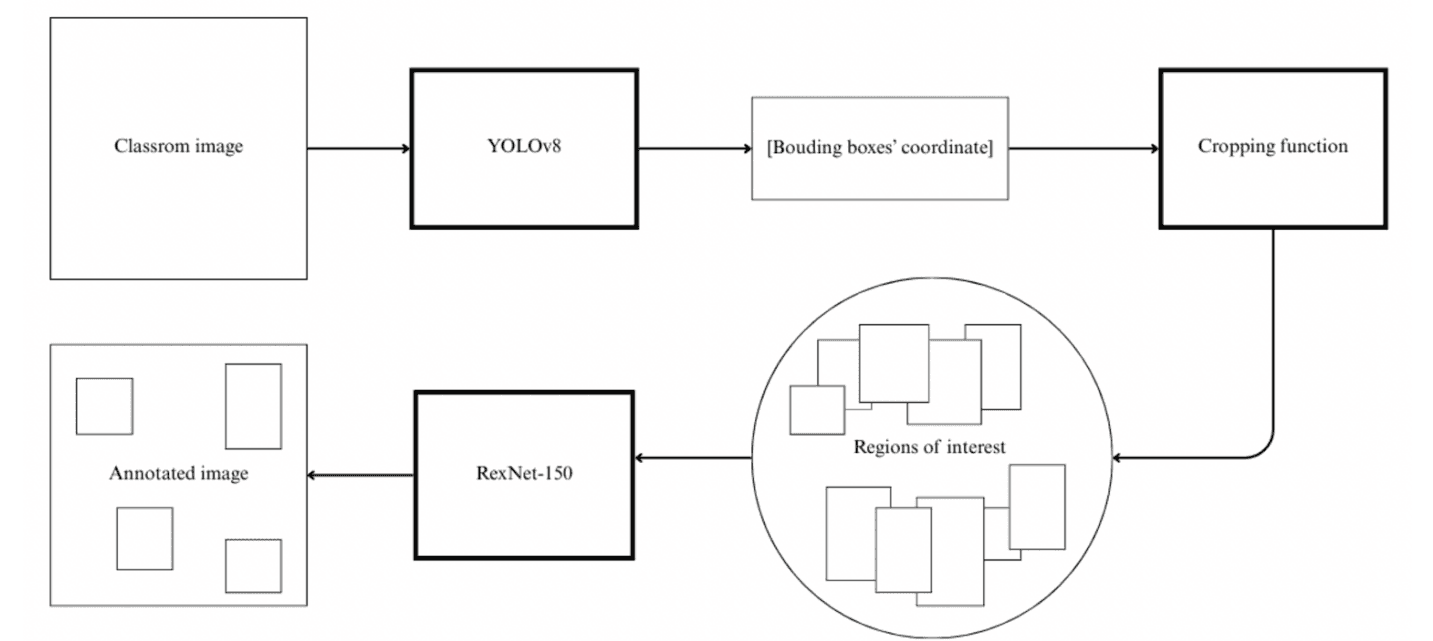
Two-stage Exam Cheating Detection (ECD) pipeline (FJCAI 2026).
1. Multi-Source Dataset Harmonization (273,897 Samples)
Cleaned and unified label ontologies across 10 open datasets into an 80/10/10 train/val/test split (219,117 train / 27,389 val / 27,391 test).
2. Stage 1: YOLOv8n Examinee Localization
Detects human subjects at 0.25 confidence threshold and filters out non-person objects and classroom background.
3. Stage 2: Fine-Tuned RexNet-150 Classifier
Classifies 224×224 examinee crops using ImageNet-initialized RexNet-150 (21.3M parameters, early-stopped at Epoch 8).
Technical Stack & Systems Engineering
Implementation Highlights
- →Consolidated 273,897 labeled samples across 10 public datasets.
- →Conducted controlled backbone (ResNet-18, EfficientNet-B0, RexNet-150) and full-frame vs. two-stage ablation studies.
Datasets & Protocol
Datasets & Corpora
- 10-Source Consolidated Exam Monitoring Benchmark (273,897 total samples; 6,895-sample evaluation set)
Evaluation Protocol
Compared Full-Frame RexNet-150 baseline against Two-Stage YOLOv8n + {ResNet-18, EfficientNet-B0, RexNet-150}.
Tracked Evaluation Metrics
Achieved 95.16% accuracy and 0.91 cheating F1 (+16.64% accuracy and +0.28 F1 over full-frame baseline) at 13.9 ms per sample.
+16.64% over Full-Frame RexNet-150 baseline (78.52%)
+0.28 over Full-Frame baseline (0.63 F1)
Real-time edge-ready performance
Empirical Analysis & Interpretation
Isolating student ROIs before classification is the single most impactful architectural decision, yielding a 28-point absolute F1 jump on the minority cheating class.
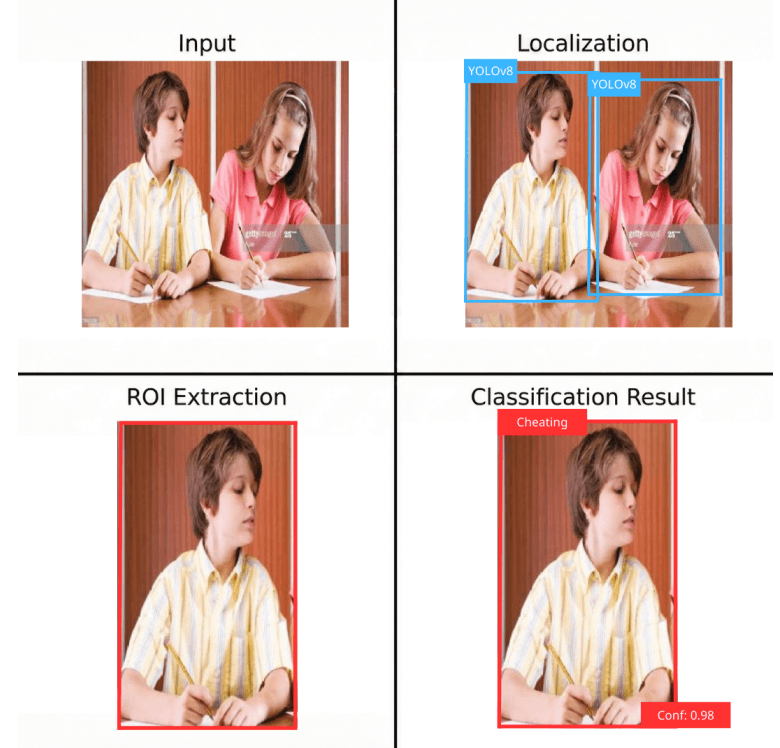
Visual inference stages: Input frame, YOLOv8 localization, ROI extraction, and RexNet-150 classification.
What This System Contributes
- 01First author: designed the two-stage pipeline, curated the 10-source dataset, ran all model ablations, and authored the FJCAI 2026 paper.
Boundary Conditions & Future Work
- ·Static frame ROIs do not capture multi-frame gesture trajectories or objects placed far outside the person bounding box.
A Two-Stage, Object-Centric Deep Learning Framework for Robust Exam Cheating Detection
Van-Truong Le, Le-Khanh Nguyen, Trong-Doanh Nguyen