FLeX: Fingerprint Leakage Evaluation across Super-Resolution and Cross-Domain Matching
1University of Science, Vietnam National University Ho Chi Minh City (VNU-HCM) · SELab
13th International Conference on Future Data and Security Engineering (FDSE 2026), Springer CCIS
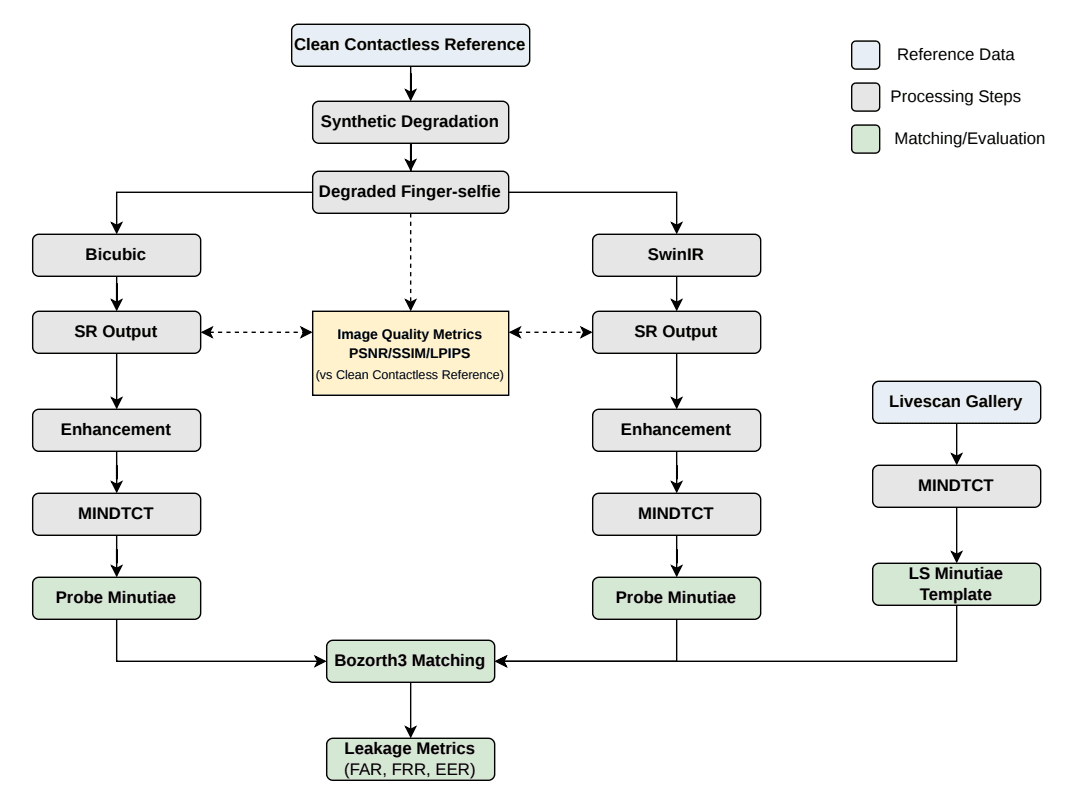
Figure 1: Figure 1: Three-level FLeX evaluation pipeline linking super-resolution quality, MINDTCT minutiae extraction, and Bozorth3 cross-domain matching.
Bicubic outperforms generic SwinIR across PSNR, SSIM (0.518 vs 0.485), and LPIPS (0.513 vs 0.572)
3.86× to 8.24× more detected minutiae compared to raw contactless images
Near-random EER ≈ 0.5 across all contactless probes (vs. 0.0638 same-domain livescan sanity check)
Paper Abstract
Contactless finger-selfies enable convenient biometric capture, but restoration of low-resolution imagery may also expose identity-bearing ridge information. We investigate whether super-resolution increases this leakage. Our evaluation links reconstruction quality (PSNR, SSIM, and LPIPS), minutiae extraction, and NBIS-based contactless-to-livescan matching on ISPFDv2. Bicubic and SwinIR are compared on identical sampled images to separate restoration effects from sampling bias. This design treats leakage as identity-specific utility rather than visual plausibility or feature abundance alone. Bicubic outperforms SwinIR in reconstruction fidelity (25.333 PSNR, 0.518 SSIM, and 0.513 LPIPS versus 24.696, 0.485, and 0.572). Although enhancement increases the mean number of extracted minutiae from 51.19 for raw contactless images to 197.50 for SwinIR outputs and 421.94 for clean contactless images, it does not improve identity separation: all evaluated contactless representations yield EERs near 0.5.
Research Motivation
Super-resolution studies frequently assume that higher PSNR/SSIM or a larger number of extracted minutiae implies greater biometric utility or privacy leakage from smartphone finger-selfies. However, enhancement artifacts can hallucinate ridge-like textures that inflate template counts without preserving genuine identity correspondence.
Guiding Research Questions
- RQ1Does generic transformer-based super-resolution (SwinIR) improve reconstruction fidelity over Bicubic interpolation on degraded contactless finger-selfies?
- RQ2Does a 3.86×–8.24× increase in MINDTCT extracted minutiae translate into actual identity leakage under cross-domain contactless-to-livescan matching?
Methodology & Architecture
We establish a three-level biometric leakage evaluation protocol over ISPFDv2 (71,040 contactless probe images across BI and RES subsets under 30 synthetic degradation conditions, matched against 2,368 livescan gallery templates): (1) Image Reconstruction Quality (PSNR, SSIM, AlexNet LPIPS), (2) Minutiae Extractability via CLAHE + adaptive thresholding + NIST MINDTCT, and (3) Identity-Consistent Matching via NIST Bozorth3 computing genuine/impostor distributions, FAR, FRR, and Equal Error Rate (EER).
Degraded Finger-Selfie Input → Parallel Bicubic & SwinIR Super-Resolution → Level 1: PSNR / SSIM / LPIPS vs. Clean Contactless Reference → CLAHE & Adaptive Gaussian Enhancement → Level 2: MINDTCT Minutiae Template Extraction (.xyt) → Level 3: Bozorth3 Cross-Domain Matching against Livescan Gallery → FAR / FRR / EER Leakage Assessment.
- · ISPFDv2 Contactless-to-Livescan Benchmark (35,520 BI contactless + 35,520 RES contactless = 71,040 probe images; 2,368 livescan gallery images; 30 degradation combinations)
PSNR (dB ↑) · SSIM (↑) · LPIPS (↓) · Mean Extracted Minutiae Count · Equal Error Rate (EER ↓)
Additional Figures from the Manuscript
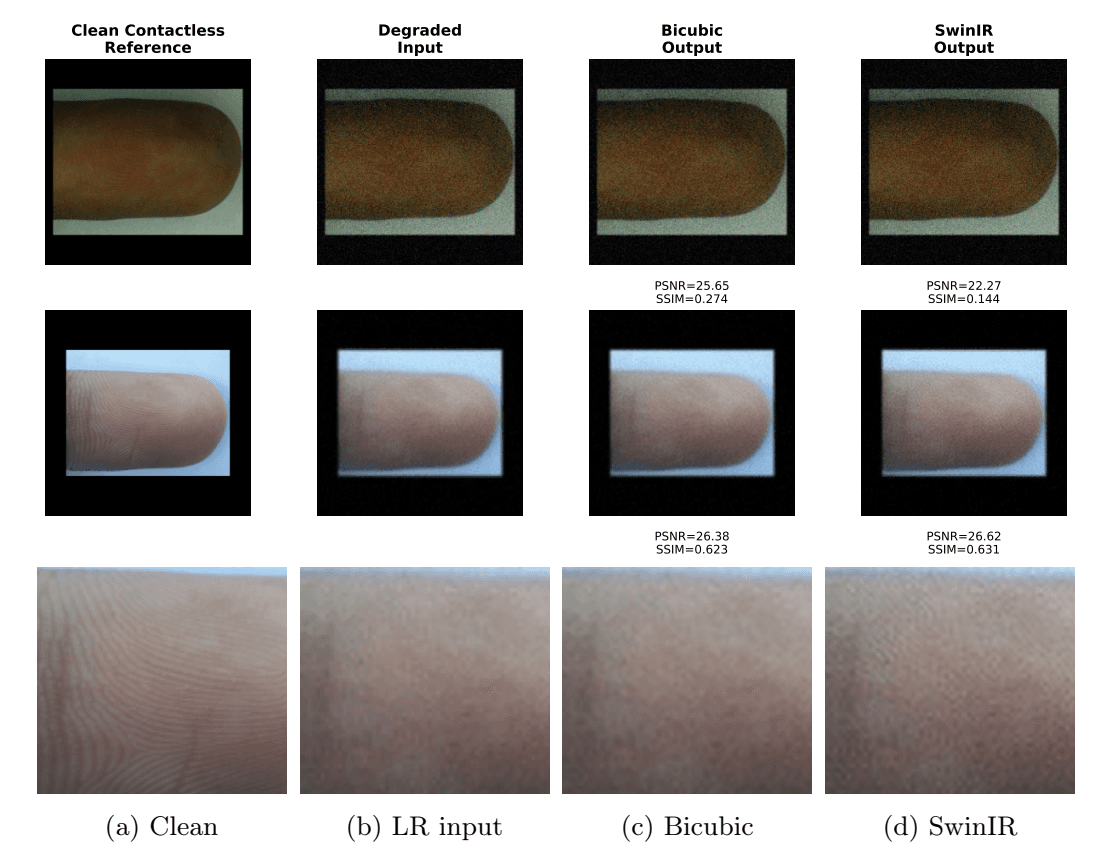
Figure 2: Figure 2: Visual comparison and ridge magnification showing texture smoothing and alteration in generic super-resolution.
Primary Contributions
- 01Introduced FLeX, a three-level biometric leakage protocol separating visual fidelity, template extractability, and downstream cross-domain identity matching.
- 02Evaluated 71,040 contactless probe images and 142,080 genuine/impostor pairs across 30 degradation regimes on ISPFDv2.
- 03Proved that super-resolution and contrast enhancement inflate spurious minutiae detections (up to 421.94 points) without enabling identity-consistent leakage (EER ≈ 0.5).
Analyzed Boundary Conditions
- ·Uses generic SwinIR checkpoints and classical NBIS (MINDTCT/Bozorth3) rather than ridge-orientation-specific deep matchers.
BibTeX Entry
@inproceedings{le2026flex,
  author    = {Le, Van-Truong and Nguyen, Le-Khanh and Vo Han, Tran-Chau and Tran Minh, Hieu-Hoc and Tran, Minh-Triet},
  title     = {FLeX: Fingerprint Leakage Evaluation across Super-Resolution and Cross-Domain Matching},
  booktitle = {Future Data and Security Engineering (FDSE 2026)},
  series    = {Communications in Computer and Information Science (CCIS)},
  publisher = {Springer},
  year      = {2026}
}