SKIA: Spatial-Knowledge Informed Attention for Robust Remote Photoplethysmography under Lower-Face Motion Artifacts
1University of Science, Vietnam National University Ho Chi Minh City (VNU-HCM) · SELab
19th International Conference on Machine Vision (ICMV 2026)
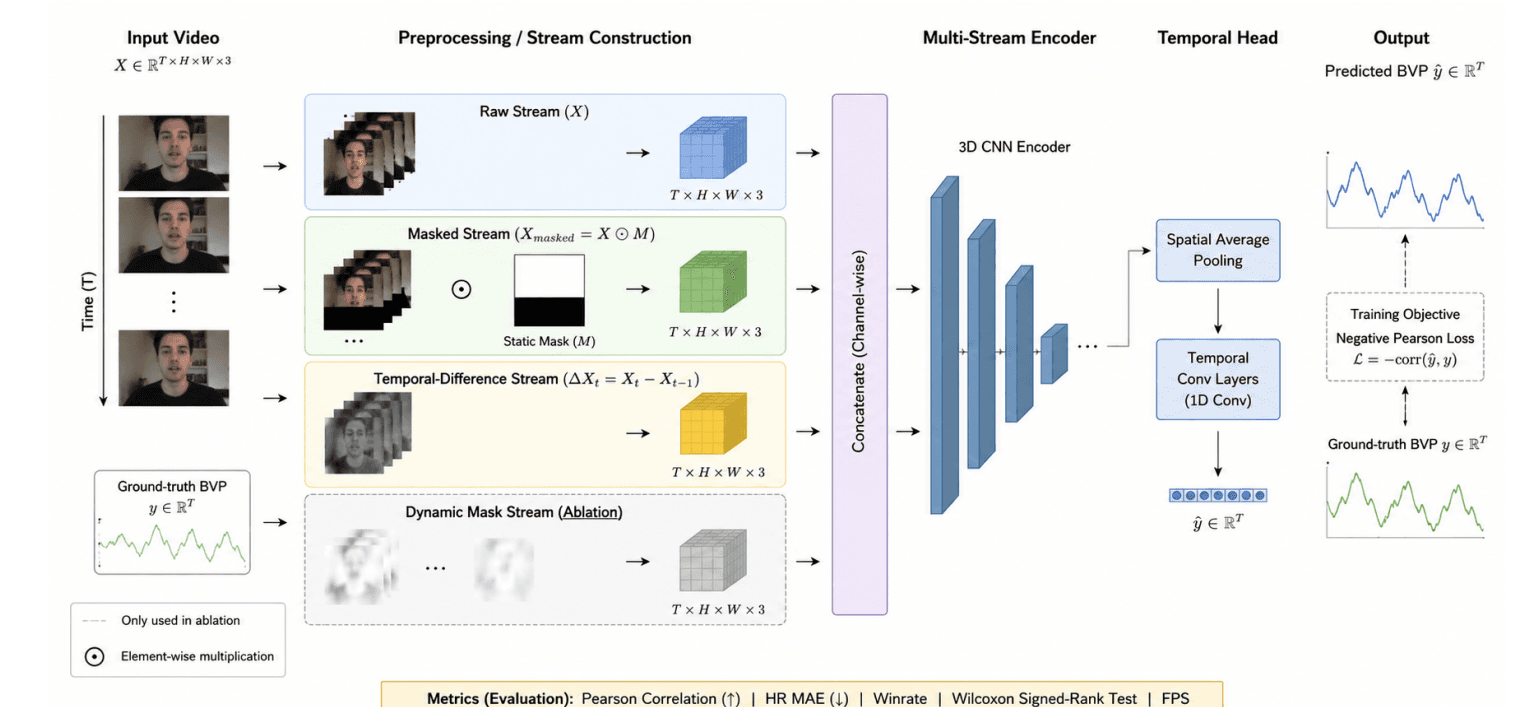
Figure 1: Figure 1: Overview of the SKIA framework combining raw frames, static lower-face suppressed frames, and temporal residuals.
Outperforms PhysNet-lite (ρ = 0.2350), SKIA Raw (8.99 BPM), and SKIA Masked (7.55 BPM)
88.1% subject winrate across 42 subjects (Wilcoxon p = 2.0 × 10⁻⁷)
Proves temporally invariant anatomical priors avoid frame-wise color sampling drift
Paper Abstract
Remote photoplethysmography (rPPG) enables contactless physiological monitoring from facial videos, but non-rigid facial motion can overwhelm subtle hemodynamic variations. Existing approaches generally compensate for global motion or learn spatial attention implicitly, leaving the effect of local lower-face activity insufficiently characterized. We investigate this effect and present SKIA, a lightweight mask-guided framework for robust blood volume pulse reconstruction. Experiments on UBFC-rPPG show that the mouth and jaw regions contribute substantial motion artifacts while providing less stable physiological information than the forehead and upper cheeks. Based on this observation, we introduce a static spatial-knowledge mask that attenuates the lower face while preserving informative skin regions. We further propose SKIA-Net, a compact spatiotemporal architecture that combines raw appearance, masked representations, and temporal residuals. Static masking improves CHROM Pearson correlation from 0.3507 to 0.4166 (p < 0.001), whereas SKIA-Net achieves a correlation of 0.7522 and a heart-rate mean absolute error of 3.73 bpm.
Research Motivation
Subtle skin-color blood volume pulse (BVP) signals in facial videos are easily corrupted by non-rigid lower-face (mouth and jaw) articulation. Paradoxically, dynamic optical-flow masks degrade rPPG reconstruction because frame-varying spatial weights alter the sampled skin color distribution over time.
Guiding Research Questions
- RQ1Can a parameter-free, temporally stable anatomical mask suppressing the lower 30% of the face improve classical chrominance-based rPPG across subjects?
- RQ2Does fusing raw appearance, static lower-face suppressed frames, and temporal differences in a compact 3D-CNN (SKIA-Net) outperform both single-stream models and dynamic optical-flow masking?
Methodology & Architecture
We define a static spatial-knowledge mask M(i,j) = 1 for i < αH (with optimal ratio α = 0.7 retaining the upper 70% of the cropped face) and validate it first on classical CHROM across all 42 UBFC-rPPG subjects using paired Wilcoxon signed-rank tests. We then construct SKIA-Net, which concatenates three aligned streams—Raw appearance (X), Static Masked (X ⊙ M), and Temporal-Difference (ΔX_t = X_t − X_{t-1})—along the channel dimension into a lightweight 3D-CNN encoder, spatial average pooling, and 1D temporal convolutional head trained with Negative Pearson Correlation Loss.
Three-stream input construction (Raw X + Static Lower-Face Masked X ⊙ M [α=0.7] + Temporal Difference ΔX_t) → Channel-wise Concatenation → 3D-CNN Spatiotemporal Encoder → Spatial Average Pooling → 1D Temporal Conv Head → BVP Waveform Reconstruction optimized via Negative Pearson Loss.
- · UBFC-rPPG Dataset (42 subjects total; 32 train / 10 test subject-disjoint split for SKIA-Net)
Waveform Pearson Correlation (ρ ↑) · Heart-Rate Mean Absolute Error (HR MAE BPM ↓) · Subject Winrate (%) · Paired Wilcoxon Signed-Rank Test (p-value) · Inference Throughput (FPS)
Additional Figures from the Manuscript
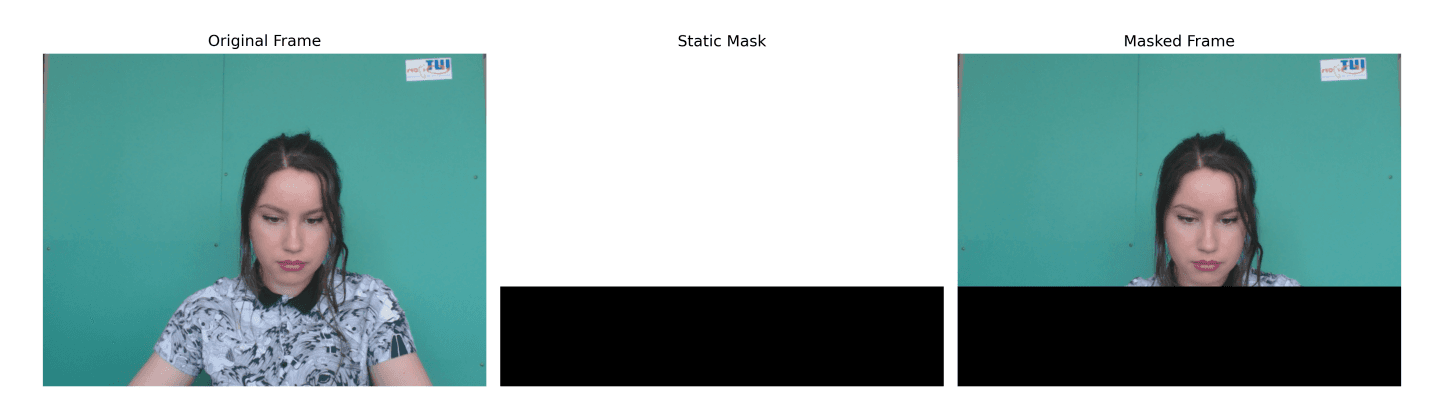
Figure 2: Figure 2: Static lower-face suppression (α = 0.7) preserving stable hemodynamic signals in the forehead and upper cheeks.
Primary Contributions
- 01Characterized lower-face motion contamination in rPPG and proved that a static anatomical prior (α = 0.7) significantly improves CHROM across 88.1% of subjects (p = 2.0 × 10⁻⁷).
- 02Designed SKIA-Net, a compact 3-stream spatiotemporal 3D-CNN achieving 0.7522 Pearson correlation and 3.73 BPM HR MAE.
- 03Demonstrated that dynamic optical-flow soft masks degrade waveform fidelity (0.1534 Pearson) by inducing artificial temporal color fluctuations.
Analyzed Boundary Conditions
- ·Evaluated on UBFC-rPPG; cross-dataset generalization to dedicated speaking-intensive benchmarks and landmark-adaptive masks remains future work.
BibTeX Entry
@inproceedings{le2026skia,
  author    = {Le, Van-Truong and Huynh, Viet-Tham and Tran, Minh-Triet},
  title     = {SKIA: Spatial-Knowledge Informed Attention for Robust Remote Photoplethysmography under Lower-Face Motion Artifacts},
  booktitle = {19th International Conference on Machine Vision (ICMV 2026)},
  year      = {2026}
}