A Two-Stage, Object-Centric Deep Learning Framework for Robust Exam Cheating Detection
1University of Science, Vietnam National University Ho Chi Minh City (VNU-HCM) · SELab
FISU Joint Conference on Artificial Intelligence (FJCAI 2026), Vietnam & arXiv (cs.CV)
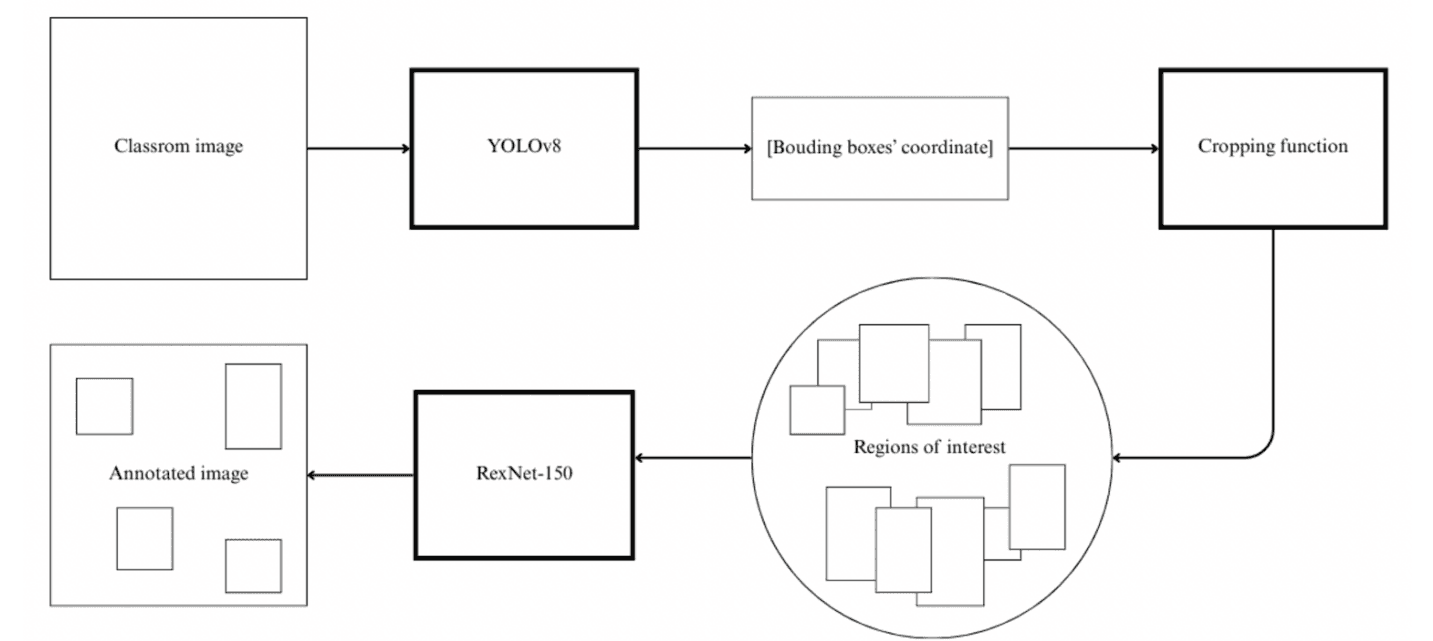
Figure 1: Figure 1: Two-stage object-centric pipeline isolating examinee ROIs via YOLOv8n before RexNet-150 behavior classification.
+16.64% absolute improvement over Full-Frame RexNet-150 baseline (78.52%)
+0.28 F1 gain over Full-Frame baseline (0.63 F1); Macro/Weighted F1 = 0.94 / 0.95
Real-time throughput (~72 FPS) on a single RTX 3080 GPU
Paper Abstract
Academic integrity continues to face the persistent challenge of examination cheating. Traditional invigilation relies on human observation, which is inefficient, costly, and prone to errors at scale. To overcome these challenges, we propose an improvement over a simple two-stage framework for exam cheating detection that integrates object detection and behavioral analysis using well-known technologies. First, the state-of-the-art YOLOv8n model is used to localize students in exam-room images. Each detected region is cropped and preprocessed, then classified by a fine-tuned RexNet-150 model as either normal or cheating behavior. The system is trained on a dataset compiled from 10 independent sources with a total of 273,897 samples, achieving 0.95 accuracy, 0.94 recall, 0.96 precision, and 0.95 F1-score — a 13%+ increase over a baseline accuracy of 0.82 in video-based cheating detection. With an average inference time of 13.9 ms per sample, the proposed approach demonstrates robustness and scalability for deployment in large-scale environments.
Research Motivation
Full-frame exam surveillance classifiers suffer from a severe spatial signal-to-noise problem: individual student actions occupy a tiny fraction of classroom pixels, causing CNNs to overfit to room backgrounds and fail in multi-person scenes.
Guiding Research Questions
- RQ1How much does decoupling person ROI localization (YOLOv8n) from fine-grained behavioral classification (RexNet-150) improve accuracy and minority-class F1 over full-frame classification?
- RQ2Can an object-centric two-stage pipeline maintain real-time inference latency (<15 ms) while generalizing across 10 consolidated datasets?
Methodology & Architecture
We harmonize 10 public exam-monitoring datasets into a unified 273,897-sample benchmark (219,117 train / 27,389 val / 27,391 test). Stage 1 uses YOLOv8n (COCO confidence threshold 0.25) to isolate `person` bounding boxes and discard classroom background noise. Stage 2 resizes cropped ROIs to 224×224 and fine-tunes an ImageNet-pretrained RexNet-150 classifier (21.3M params, Adam lr=3e-4, early stopping at Epoch 8), comparing against full-frame RexNet-150, ResNet-18, and EfficientNet-B0 baselines.
Classroom Surveillance Frame → Stage 1: YOLOv8n Person Detection & Filtering (τ = 0.25) → ROI Extraction & 224×224 Normalization → Stage 2: Fine-Tuned RexNet-150 Behavioral Classifier → Privacy-Preserving Post-Exam Reporting.
- · Consolidated 10-Source Exam Behavior Benchmark (273,897 total samples; 6,895-sample held-out evaluation split)
Overall Accuracy · Minority-Class ('cheating') F1-Score · Precision & Recall · Inference Latency (ms/sample)
Additional Figures from the Manuscript
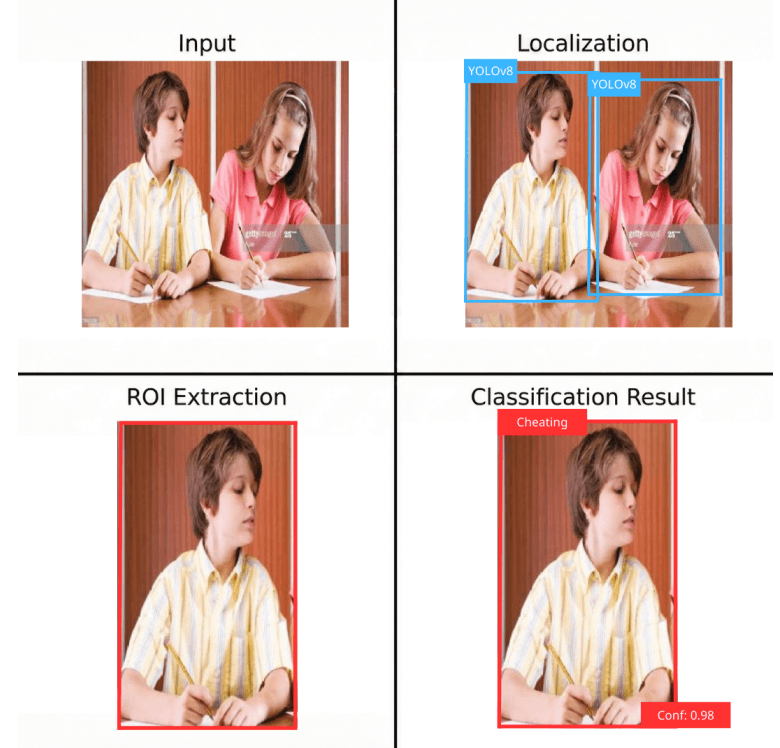
Figure 2: Figure 2: Step-by-step inference visualization from multi-person classroom frame to isolated ROI classification.
Primary Contributions
- 01Proposed a two-stage object-centric exam behavior analysis pipeline pairing YOLOv8n ROI extraction with RexNet-150 classification.
- 02Curated and standardized a 273,897-sample benchmark dataset consolidated from 10 disparate public sources.
- 03Demonstrated a +16.64% accuracy and +0.28 cheating F1 gain over full-frame classification in controlled ablations at 13.9 ms/sample latency.
Analyzed Boundary Conditions
- ·Tight person bounding boxes can occasionally exclude peripheral desk items (e.g., a phone outside the crop), and single-frame classification lacks temporal gesture continuity.
BibTeX Entry
@inproceedings{le2026twostage,
  author    = {Le, Van-Truong and Nguyen, Le-Khanh and Nguyen, Trong-Doanh},
  title     = {A Two-Stage, Object-Centric Deep Learning Framework for Robust Exam Cheating Detection},
  booktitle = {Proceedings of the FISU Joint Conference on Artificial Intelligence (FJCAI 2026)},
  year      = {2026},
  note      = {arXiv:2604.16234}
}